
Visual by Julie McMahon, Creative Director
Every day Connecticut College students’ e-mail inboxes are bombarded with messages from the Office of College Relations. The topics of these memos range from alumni luncheons to new stop sign installations. As it can be difficult to keep up with the constant influx of information, many of these e-mails end up being discarded without their contents ever being examined past the subject line. However, one of these emails, inconspicuously titled, “A Message from the Campus Safety Department,” held some interesting and unexpected data.
Attached to the e-mail was the annual security report. The twenty-page document described Connecticut College’s policies on security, alcohol and illicit drugs and sexual misconduct, as well as crime definitions and a list of important phone extensions. But the truly intriguing substance is tucked away into pages seventeen through nineteen on the Crime Statistics Tables.
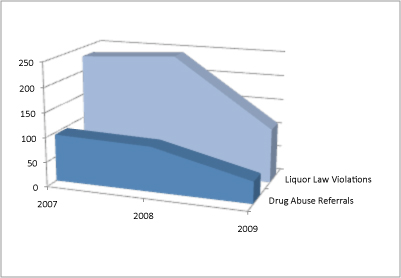
The tables show data collection from 2007, 2008 and 2009 on a wide range of criminal activity, such as hate crimes and manslaughter, both of which show no incidents over the past three years. Drug abuse and liquor law violation referrals, though, display a different pattern on the statistics table. In 2007, there were 103 referrals for drug abuse on the entire campus, followed by 102 in 2008. In 2009, the number of referrals drastically dropped to 56, almost half of the previous two years. Liquor law violation referrals showed a similar trend, with 349 and 319 referrals in 2007 and 2008 respectively, and only 146 referrals in 2009.
So what factors can be attributed to the drop?
Stewart Smith, Director of Campus Safety, said, “The drop has its roots in the partnership my department has with Student Life. We are working more effectively with Student Life to help keep students safe.”
Smith also notes that the increase in student leadership roles: housefellows, floor governors, and peer educators help students look out for one another and intervene “in a preventive way before Campus Safety has to be called.”
However, the decline of alcohol and drug related referrals in 2009 still comes as somewhat of a surprise to students on campus, as alcohol and drug abuse is often presented as growing problems, rather than improving situations.
“A lot of seniors say that the drinking scene seems even more extreme now than when they were freshman, ” said Carter Goffigon ’14, a new member of the Health Peer Educators.
Bizzy Gart ’11, treasurer of Health Peer Education, confirms Goffigon’s statement, admitting, “I’m surprised that the number of reports have decreased, because in the past four years, the amount of alcohol consumed on campus has definitely increased.”
Gart believes that reduction in referrals is due in part to a change in Campus Safety’s approach. “Campus Safety is trying to promote security and safety within the community, rather than acting as a police force,” said Gart.
Smith also affirms that first and foremost, “Campus Safety officers care about students’ safety.”
Gart agrees with this strategy by Campus Safety, but does not believe that the reduction in alcohol related referrals accurately depicts a reduction in alcohol abuse by students.
“I think that students drink more now than ever,” says Gart, “because instead of drinking occasionally throughout the nights, people drink in their rooms before going out, so they end up drinking much more, much faster.” This practice by the students could also play a role in the decrease in reports, because they are not drinking in as open, social environments.
While the statistics may imply a surprising increase in sobriety on campus, the truth is not so cut-and-dry.






This is a great topic, and really well written. But I don’t believe that alcohol and drug use on campus is a growing problem in the slightest.
“‘A lot of seniors say that the drinking scene seems even more extreme now than when they were freshman,’ said Carter Goffigon ’14, a new member of the Health Peer Educators.”
What seniors? I certainly don’t. This feels like an inference. Where are the students that aren’t involved in CCPeeps, and what are their opinions? We all know that even Health educators drink in the same ways as most other college kids on this campus. Why should we believe them?
The violations seemed to drop because campus safety is not playing as much of an active role in patrolling parties. The college is just turning a blind eye to this. There is no way that alcohol consumption has not risen. Visit south campus on a Thursday or Saturday night and you will see my point.
For the three years I’ve been here, the partying in South campus has always been the same. There is no tangible evidence that can suggest that alcohol consumption has risen and not stayed the same.
This is a college. Every college has to turn a blind eye to drinking to a certain extent, because students will always drink. Campus Safety has done a great thing in beginning to offer students the ability to learn their limits for themselves. Due to the nature of US liquor laws, underclassmen are bound to overdo it, whether Safety acts as a police force or not, and isn’t it better that they do so in an environment as safe as this? To patrol more and crack down on campus drinking will only hurt the atmosphere of mutual respect, and will remove us even further from the real world. It’s not the college’s place to treat us like we’re children, and in this case they’ve finally begun to understand that. Why complain.