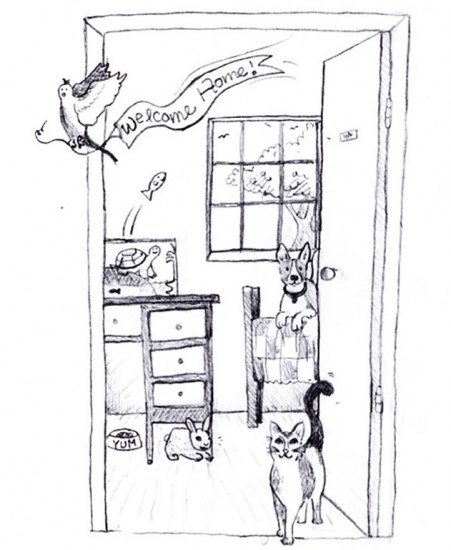
 Across the country, colleges are opening up their doors and dorms to all kinds of animals, and not those typically seen on a college campus. Increasingly, more and more colleges are loosening their policies on having pets in dormitories.
Monroe Hall, a dormitory at Washington & Jefferson College in Pennsylvania, allows residents to keep pets in their dormitories. The permitted animals include turtles, guinea pigs, birds, cats and dogs under forty pounds, as long as the dog’s breed does not include any mix of pit bull, Rottweiler, or wolf. Massachusetts Institute of Technology has “cat-friendly areas,” where students are permitted to keep cats as pets. Both schools hold students responsible for the actions and wellbeing of their pets, and both reserve the right to “expel” pets from their campus for any number of reasons.
Middlebury College also allows small animals to be kept by students in appropriate aquariums or cages. Exceptions to the policy are snakes and ferrets, which are not allowed in residence halls at all. The idea behind such a policy is, in part, to help ease the transition of going to college.
Connecticut College’s pet policy can be found on page sixty-five of the 2010-2011 Student Handbook and reads as follows:
“Students are not permitted to keep pets in residential houses. Fish in ten-gallon tanks (or less) are permitted. Only animals that can survive submerged under water are allowed; snakes, turtles, frogs, hamsters, mice etc. are not permitted in the residence halls. When a pet is found, the student must remove the pet from the residential area within 24 hours. There is $75 fine for each violation.”
While allowing dogs in residence halls may be extreme, it seems as though Conn’s policy is on the opposite end of the spectrum. However, not everyone at school adheres to Conn’s pet policy. One student keeps two turtles, and shall remain anonymous for obvious reasons, believes that “having small pets at college can be a great thing for the right people.”
Though the student does not necessarily think that freshmen with roommates should be allowed pets on campus, she is of the opinion that sophomores and upperclassmen with single rooms might find that “the unconditional love and companionship of a pet can be extremely comforting.”
“As a sophomore, I brought my turtle to school as I had my own room, and it was not only a fun thing for me but a great way to make friends,” explained the student. “Living in the Plex can be hard because often there is a negative stigma about leaving doors open because of the way the dorms are structured, but as I had my turtle tank in plain sight of the door, people I had never met before would stop in to chat when my door was open.”
The student also said that “it often feels good to take care of something, whether it be a small pet or even a plant. Having a pet on campus can help students feel less homesick and even prevent them from going home every weekend if they live close to campus.”
Of course, those with allergies and who dislike animals would oppose the points made by the turtle-owner, but it seems as though many colleges have dealt with such issues by creating a distinction between pet-friendly areas and the rest of the campus.
While it’s unclear as to whether or not Conn would consider amending its current policy on pets, it appears to be a growing trend throughout colleges and universities. Many students are content with just having a small fish, or no pet at all, but for others, a guinea pig, cat or even a turtle can make all the difference.