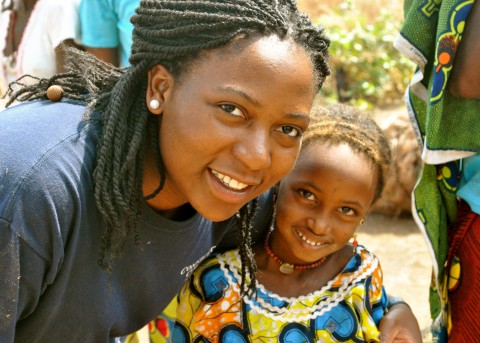
Fabiola Miakassissa ’13
“When my teammates and I arrived in Chongashe and saw the vastness of the dry village,” began Fabiola Miakassissa ’13, “I was breathless.”
Over winter break, Miakassissa and three other students – two from Middlebury and one from Smith – volunteered in the rural village of Chongashe in northern Ghana in order to implement a safe and sustainable water system with an non-governmental organization (NGO) called Community Water Solutions. Miakassissa addressed some of the details of the water system, but chose to focus more on the dangers of preconceptions about unfamiliar places.
Upon arriving in Chongashe, one of Miakassissa’s partners turned to her and said, “Fabiola, I feel so sorry for these people, they’re so unprivileged.” Miakassissa replied, “How do you know? Ask them and see if they feel unprivileged or not.”
Miakassissa used this story to illustrate how a person’s preconceptions can prevent him or her from fully engaging in a new place. Americans may consider themselves privileged because of luxuries like cars, television, and the Internet, but Miakassissa suggests that privilege cannot be measured in such a materialistic way. In automatically assuming that the people of Chongashe were underprivileged, Miakassissa’s partner was prevented from fully seeing and understanding the lives and culture of the people they were there to assist.
Preconceptions, however, work both ways. Miakassissa was sure not to exclude the negative effects of preconceptions of the West in her discussion. She arrived in Chongashe right in the middle of the harvest, when villagers were collecting their yams and bringing them into the market to be sold. However, one man had failed to plant any yams that year and sat idly by while the other villagers harvested. Miakassissa approached this man and asked him why he did not have any crops of his own. He replied that he had heard that white men were coming with better seeds and bigger machinery that would make planting and harvesting much easier. He was waiting for their assistance before planting anything else in his plot.
The man had no validation to his claim, and was simply relying on a rumor, yet he was absolutely sure that help was on its way. “Westerners think that Africans need saving,” explained Fabiola, “and some Africans begin to rely on Western assistance, whether it’s coming or not.”
Miakassissa and her team tried to dispel these assumptions by “giving a sense of ownership” to the villagers over the clean water system they installed. Rather than install the system for the villagers, her team involved them in the project. “We decided to train two women to use the alum and aqua tabs, and we decided to charge the villagers five cents per bucket of fresh water.” With this money, the women will be able to buy more alum and aqua tabs, and will also receive two dollars a month for their work.
Although involving the residents of Chongashe in the project may have decreased their feeling of dependency on Western aid, Miakassissa was doubtful that it did anything to decrease her partners’ conceptions of the village’s lack of privilege. Upon their departure, many students felt as though they had “saved” the villagers.
“They failed to actually understand the place,” said Miakassissa. “Those people in the village did not need saving, just helping. Approach anywhere you go with an open mind, and engage with the full stories of that place, the bad and the good.”
“Engage yourself fully,” concluded Miakassissa. “You won’t know the culture of a place until you are a part of it.” •