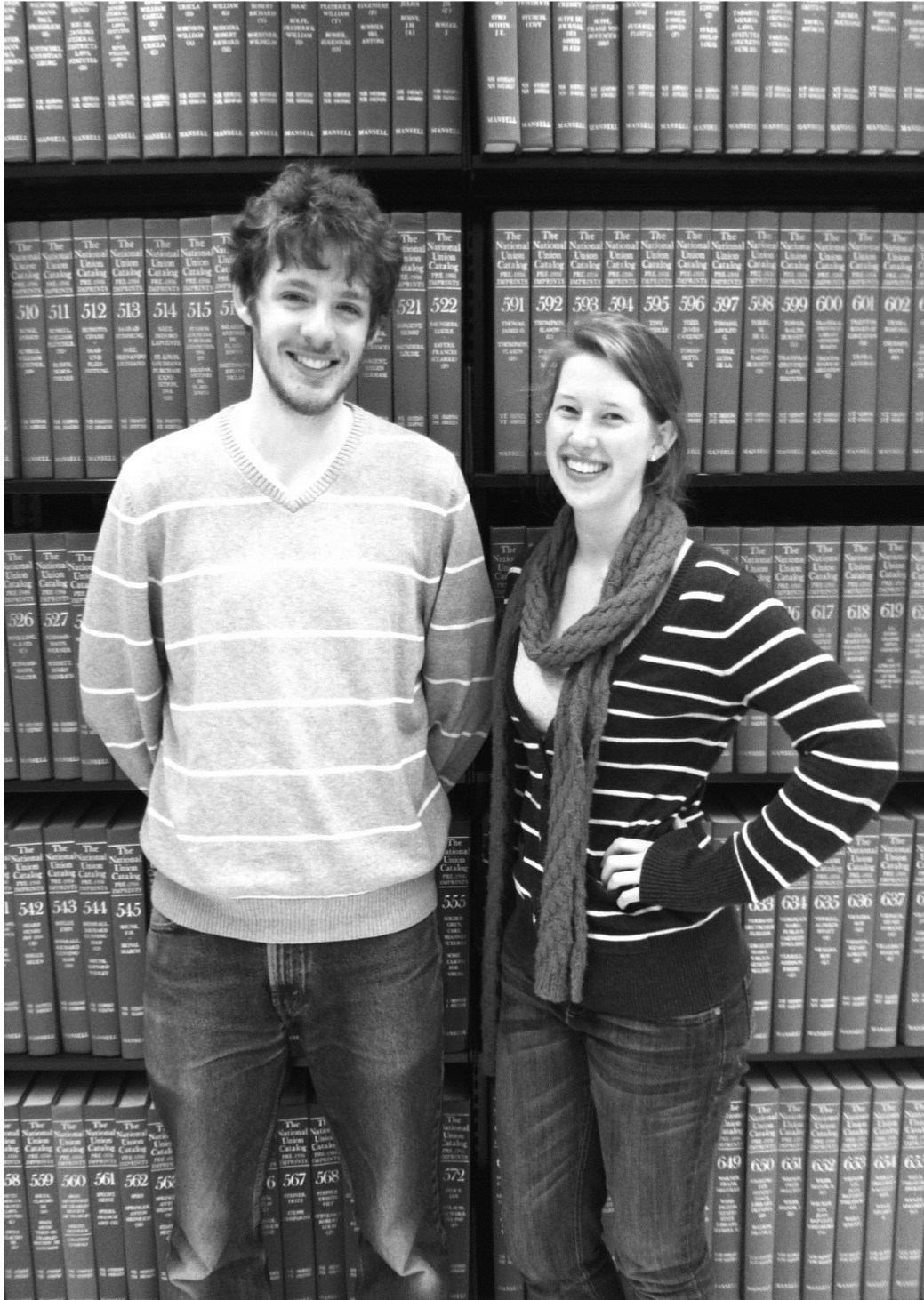
Research scholars Dan Brown and Sarah Lamer
The Wabash National Study of Liberal Arts Education (WNSLAE) aims to collaborate with liberal arts institutions nationwide to develop evidence to improve liberal arts education through a three-year project.
The Wabash Study 2010 includes thirty colleges and universities across the country, including Connecticut College. The study seeks to discover the inputs, experiences and outcomes of college academics. For the sake of the study, inputs are defined as “the perspectives and values that students contribute upon arrival to college,” experiences are “what impacts the students while in college” and outcomes are “the impact that college has on student ability and knowledge.” The findings of these surveys will then be used to create and implement changes to ameliorate targeted problems at individual institutions.
Prior to this study, all of Conn’s work with the Wabash Study had been in the form of survey data. Now for the first time, Conn is involved. Two Conn students, Daniel Brown ’13 and Sarah Lamer ’13, are the designated “research scholars” for the Center for Teaching and Learning (CTL), which is responsible for helping professors improve their teaching practices.
“The goal of the Wabash study,” Brown explained, “is to add voices to the numerical data about the academic student experience. As part of the study, Conn has been gathering numerical data describing Conn students. My and Sarah’s job is to conduct survey focus groups to gather qualitative data to supplement the numerical findings.”
Both students applied for this opportunity through CTL. Last year, they traveled to Wabash College, an all-male college in Indiana, with Michael Reder, Director of CTL, and psychology professor Stuart Vyse.
“While at Wabash,” said Vyse, “we met with students and faculty from other schools who were engaged in similar projects. After listening to these other researchers and hearing about their experiences, we all returned from Indiana with a much clearer idea of what we wanted to do and how to do it.”
At Wabash, the students were also trained in focus group methods.
“The focus groups are meant to investigate academic experience,” said Brown, “We aren’t talking about Harris or other aspects of campus life. We are concerned with how Conn is as a school, in comparison to similar schools around the country.”
At Conn, the focus groups are comprised of 5-8 randomly selected individuals and last about an hour long. The questions are pre-prepared for the participants, and all data is kept confidential. After all data has been collected, Brown and Lamer will present the findings to student and faculty groups. The students conduct the focus groups completely independently. “I supervise their work and, as part of this CTL project, they are enrolled in individual study courses with me,” said Vyse. Other than Vyse’s involvement, no faculty or professors are included in the research project.
The study not only advocates data-gathering and assessment, but promotes and facilitates change on each campus. At the end of the project, this will be done through on-site visits, meetings and workshops designed to ameliorate each specific weakness.
Brown also felt that the research process provides a unique opportunity to the students who are selected. “The cool thing about the study,” he described, “is that many of the students’ voices will actually be heard by those who have the power to change our school.” •