
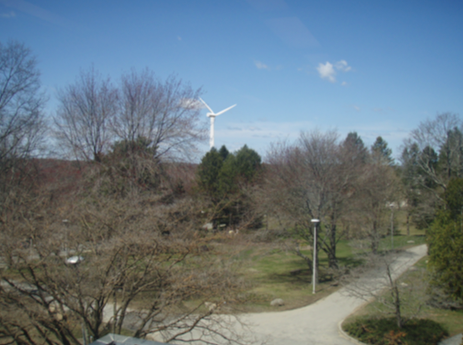
Photo from Marshall's presentation.
Connecticut College is windy. Whether students are enjoying the ocean breeze on a cool spring day, or cursing the blizzard-like conditions on their way to class, it seems as though the air is never still on our hilltop in New London. It seems only natural that Conn, a community which prides itself on its dedication to being environmentally friendly, would explore the feasibility of wind-generated power on campus.
Senior Michael Marshall has done exactly that. He presented his research to a small but engrossed audience in Olin on the afternoon of April 29.
“In 2006,” Marshall began, “a company called Global Energy Concepts, or GEC, did a study for Conn to find out how much energy a wind turbine on campus could produce.” At the end of this study, GEC concluded that it would be impossible to generate enough wind energy on campus in order to provide the school a significant amount of power.
Despite this conclusion, Marshall pursued his own research and not only found fault in GEC’s investigation, but also created a proposal for developing a wind turbine on campus that has the potential to be extremely effective.
When GEC conducted their study with Connecticut College the college’s specific location was neglected. The company used wind speed data collected at the Groton-New London Airport, which, unlike Conn, is not on a hill. Marshall explained that the college’s elevation provides two benefits in regards to increased wind speed. First, when wind climbs up a gradually inclined slope, such as the slope from the ocean to the campus, it increases speed. Second, in the winter when it is cold by the shore, there is a layer of warm air that sits at higher elevations. While the cold air is still, movement can still occur in the warmer layer of air in which Conn’s campus is situated. These benefits may not amount to much increase in actual wind speed, but “ because velocity is cubed in the equation for wind power, small increases matter a lot,” explained Marshall.
When Marshall measured wind speed on campus, even his most conservative calculations suggested a five- to ten-percent increase in wind speed when compared to GEC’s calculations. However, turbine location remained an issue.
“When people come to our campus, they want to see this,” said Marshall, pointing to the view of Long Island Sound. “Not this,” he continued, pointing to a digitally added wind turbine obstructing much of the view.
Marshall’s solution is to place the turbine in the back of Conn’s arboretum. In this location, using a turbine developed by a company called Gamesa, Marshall suggests that the school could generate over 100% of the energy it uses. At this location, special attention would have to be paid to how the turbine affects the lives of residents of a neighborhood less than a quarter mile away from the turbine.
One potential negative effect is “flickering,” which occurs when sunlight passes through the spinning turbines causing the light to flicker. The noise generated by the turbine also has to be taken into consideration, but Marshall explained that the flickering would only amount to twelve or thirteen minutes a day for part of the year and the noise would be near inaudible.
Marshall admits that there are sources of error in his study, but given Conn’s unique location, there is great potential for success in generating wind energy for Connecticut College. •








I was just wondering how many windmills y’all would need to offset how much carbon and pollution your higher education at this college creates.
Ive seen the cars the kids drive, either old pieces of junk or some fancy displays of conspicuous consumption.
Your grass is nice and green, no, not the medical marijuana you smoke, not a weed in sight pretty green sterile grass.
Seems odd really, its not like you produce anything that should justify the amount of pollution you are creating.
All while being so critical of the world outside your walls.
Odd indeed.