
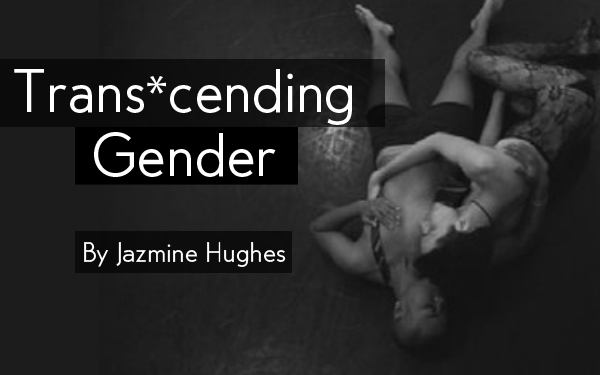

Matty Burns '13 and Lamar Ok '12.
“Will you make sure to put the star after you type trans*?” Lamar Ok ’12 and Matty Burns ’13 are sitting behind me in the College Voice office. After throwing old copy edits into a pile and wiping the table clean of old popcorn kernels, I start typing some preliminary notes as they murmur about the success of their recent collaborative project, last Tuesday’s Trans* Show.
Ok sits, legs splayed, in a beanie hat and a small silver hoop earring in his left ear, Timberlands unlaced. Burns sits opposite him, legs tucked one under the other, sunglasses never coming off from the time we meet in front of Cro’s Nest to the time when, late for a lunch date, Burns rushes out, goodbyes and thank yous still hanging in the air.
“Sure,” I tell them. “What does the star mean?” Our head copy editor is bound to ask.
“The star means fluidity,” Ok tells me. “Writing simply ‘trans,’ without the symbol, can still imply a binary: transwoman or transmale. The asterisk is an all-inclusive term for identities that conceptualize gender differently, which includes genderqueer individuals.” Both Ok and Burns self-identify as trans*, with Ok comfortable with “he” and Burns preferring simply “Matty.”
Their diction contains its own fluidity—Burns and Ok easily weave in and out of each other’s explanations and experiences, often completing each other’s sentences, reminding the other of an anecdote they should include or citing the other as an inspiration for action.
Though the two were familiar with each other for some time, they began to develop a serious, working friendship after the creation of Versum, a club and support group for trans* students.
“We started thinking about it last spring, because there wasn’t a space for trans*-identified students to talk to one another and express how they felt,” said Ok. “I think there was actually a huge bloom in genderqueer students the semester before, so there was an urgency to create a space to collect ourselves and deal with the holistic wellbeing of ourselves and each other.” A dance and English double major from Methuen, Massachusetts, Burns uses movement as an extension of Matty’s words, pushing and pulling apart Matty’s hands to evoke the increase.
Ok, a Providence-born human development major, is working towards a certification in education and will be student teaching next semester. In keeping with his didactic training, he tends to edify, thoroughly explaining every term with which I am unfamiliar and providing me with examples.
In SGA terminology, Versum, which operates through Unity House with the support of the LGBTQ Center, is an affiliated student organization, retaining all the benefits of a club except SGA funding. Their Saturday afternoon meetings, generally held in Matty’s room, are small and intimate.
“We check in with each other emotionally, really, and talk about relationships, transitioning (if students are), what bathrooms to use. We just talk about stuff. Human stuff,” said Burns.
“Part of us making it an official club is because we didn’t want it to have to be rebirthed every time trans* students flux,” Burns continued, gesturing between their chests. “Lamar and I are graduating within a few years, but there will always be trans* students on campus.”
In the second meeting of the year, Ok proposed that the group create a show to portray their experiences.
In formulating the show, Ok was inspired by transmale performer Sunny Drake, after seeing him in a production sponsored by the Theater Department. “I spoke to Drake through email, and I really wanted to educate the community [about] what it means to be trans*, but I needed it to be a group thing.”
The reactions were mixed: some people were receptive, some were highly uncomfortable. Burns, however, was completely on board.
“I came into the semester wanting to do an exploration of gender—I’d been working with Heidi Henderson, of the Dance Department, in exploring gender through pieces, so I had a lot of ideas of my own, but Lamar really set the tone of the show, and that really got me motivated in creating and branching out way beyond just movement. Then the show became more than just us—we incorporated other trans* students, and our friends, and ReFlexion. And it became a production!”
The show, held in Cro’s Nest, was an intimate portrait into two trans* students, rife with monologues, spoken word, dialogues and supporting pieces by friends and allies of the trans* community.
Ten minutes before the show began, there was only standing room left as groups of people crowded at the outskirts of the door, and spilling out into the hallway. The noise of people entering the building a floor below drifted up into the room—any disruptions were met with a resounding “shh!” and a snap back to attention.
“Can I just say that Matty and I expected maybe fifty people?” said Ok, throwing his hands in the air in exasperation. Burns laughs. “There were over 200.”
The Trans* Show commenced with Burns and Ok performing contact improvisation, a form of dance in which partners must continuously stay in contact. “An Afternoon in the Arboretum,” an improvised dialogue that revolved around a dissection of a conversation between Ok and a former lover unable to grasp his gender exploration, followed soon after.
Throughout the evening, the two ranted—“Not Gloom, but an Intellectual BOOM in Matty’s Room”—and raged, punctuated by songs, spoken word pieces and a monologue by Gender and Women Studies professor Mab Segrest on both sex and gender as a social construction.
“Our skits and dialogues were improvised. It was important that the show was authentic to us in the moment, so to solidify any language about what our gender identity felt inauthentic, because we wake up every morning and feel a little bit different about our gender experience,” said Burns.
The two focused throughout the performance on motion and movement. “The physical aspect was surprisingly,” Burns trails off. Matty thinks for a moment, and announces, “I always forget that nakedness is a thing! And I know that can be hard for some people. But Lamar really set the tone for the show…”
“…But Matty really brought the physical aspect,” Ok finishes, eager to compliment his partner in performance. “For Matty to put Matty’s body out there, that encouraged me to explore my body. It gave me the courage to think about how I feel about my body, so I added that to my performance, inspired by Matty’s physicality and its relation to Matty’s identity.”
“There’s a way to find a language in movement that I feel makes it easy for me, because words can be so limiting sometimes, whereas with the body you can say so many things at the same time,” Burns explains. “I love exploring and playing with the meaning of our body, with different clothes and different postures and that can make so many different things. Plus, I think there’s something so beautiful about the human body, in all its shapes and sizes and various degrees of nudity,” Matty grins.
“Our show conveyed a lot of messages about gender and sexuality, but I don’t want to ignore race,” Ok asserts. “Race is big. Being a trans* of color is completely different from being a white trans*. I wrote a letter to my mother, as a piece, and explaining to her why I wasn’t able to tell her I was her son because of racial and class barriers which I grew up with.”
Burns nods. “I think that was a really strong aspect of our show. So often in queer trans* movement, the conversation is often white-dominated, and assumptions of how to come out and express yourself are really based in race or class, and it’s not that way for everyone. I think that it was an important part of the show when Lamar said there’s no time to be queer, because there are so many other racial burdens. If one day I wanted to give up and become ‘straight,’ I’d tap into all this privilege, whereas Lamar couldn’t. You can’t talk about Lamar’s trans* experience without talking about race and class. Nor mine!”
After the show, Ok and Burns held a question-and-answer session.
“I liked the kinds of questions people asked. We were expecting ignorant questions, but everyone had an awareness. In other forums, there was a lot of emphasis on the body, the physical, but these were people questions. Human questions, about the human-human interaction,” said Burns.
Burns’ and Ok’s aim—to break down cultural stereotypes and expectation of gender, and present a newfound perception of gender informed by fluidity—was largely successful.
The triumph of the show prompts rumors of an encore, to which Burns and Ok smile and shrug their shoulders. They’re overwhelmingly happy with the reaction they’ve received. “We’ve had such an outpouring of emails and thank yous, and people have really expressed a desire to be authentic, and it was such a gift to be able to give that to the community,” said Ok.
“The show was our show. It was for the community, but it was also really for us. I’m thrilled beyond anything that so many people came and were supportive and were engaged—and even more, it didn’t feel like a pity-driven engagement, but questioning gender and finding the freedom to be yourself,” said Burns, squirming with happiness.
The two chatter away while I try to catch my typing up to their words, when, suddenly, Ok burps. “That’s not a man thing. That’s a human thing.” He grins wickedly. •





[…] for you all, however, my friend Jazmine Hughes beat me to the punch and actually published an excellent piece/interview with two trans* (you’ll get it once you read the article) students from her school, […]