Courtesy of Mia Whipple
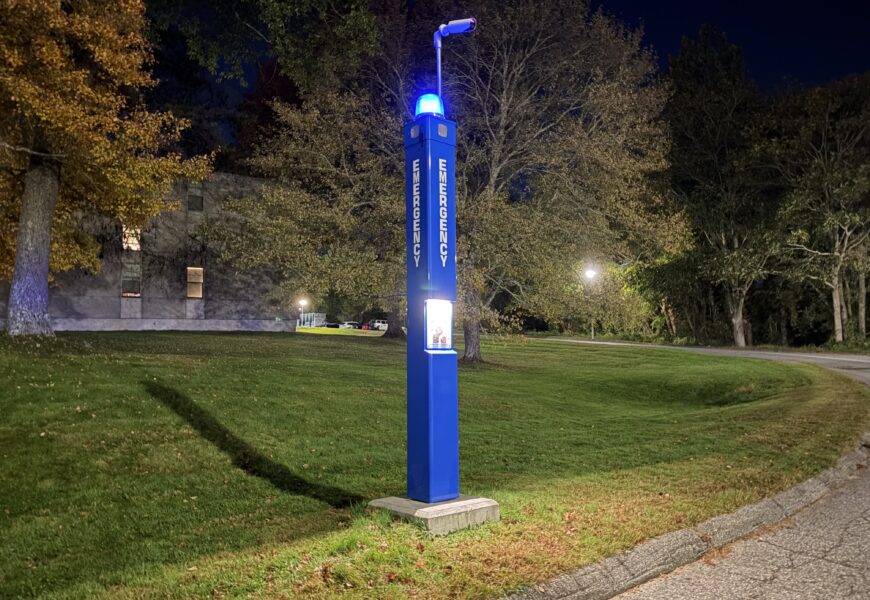
UConn’s recent decision to remove most of its blue light emergency phones has faced immediate backlash and disagreement, even sparking a lawsuit. The question at stake here is important: how much should a university be willing to sacrifice in the name of cost efficiency? Although UConn has defended the decision by citing its minimal use and high costs, removing a staple campus emergency system is a major mistake.
The purpose of the blue light system is straightforward: to provide a quick and direct connection to help when an emergency occurs. While UConn argues that mobile phones have made the system largely unnecessary, I don’t believe that new alternatives should automatically fade away. The Limited use is the major justification for its removal. Over five years, the university reportedly received 166 calls through the blue light phones, with only two involving legitimate safety concerns. Maintaining the system costs more than $70,000 annually, with a modern system costing $6 million if it were to be implemented.
Universities have limited budgets, so it is reasonable to evaluate various costs and assess their worth. However, campus safety should be one of the last things eliminated by costs. The university has a responsibility to provide students with an environment where they can pursue their education without having to question whether help will be accessible when they need it. The system doesn’t guarantee safety, of course, but maintaining multiple ways to contact emergency services can only help. Blue light phones are not meant to be used frequently. The whole point is for situations in which someone needs immediate assistance, and a university should hope that people need to use it as minimally as possible.
I know many people who are students at UConn, and not a single one endorses the plan. As one student expressed, “The lack of use could also show they are scaring people away from violent acts”. This is exactly my point: The absence of frequent emergencies doesn’t mean that people have not been deterred from violent acts by visible emergency systems. If you install security cameras at your house to prevent home break-ins, it would make no sense to uninstall them because no one has broken in. It is no more likely that the lack of break-ins was caused by no potential intruders than it was by successful deterrence, and it feels extremely unwise to assume the first at the potential expense of safety.
UConn has encouraged its students to use their phones to contact 911 and/or the LiveSafe app. The places that lack cell service will continue to have a blue-light phone, which is certainly better than a complete removal of the phones. However, I don’t agree with assuming that students will be carrying a readily accessible phone in times of need. Even granting the unfounded assumption that people do carry their phones everywhere they go and that everyone has one, they don’t have infinite battery. The party scene is big at UConn, and people’s phones are likely to die if they are out super late. Further, if someone is intoxicated, it’s much easier to see and use a blue light phone than a regular mobile phone that may be stored away in a bag.
In my opinion, UConn couldn’t have chosen a worse time to announce this. As the recent outrage surrounding Cornell’s handling of a sexual assault has started a national conversation about campus safety and administrations’ handling of such issues, UConn is moving in the opposite direction by eliminating a resource designed to help students with emergency assistance. Although the two situations are different and blue light phone accessibility was irrelevant to the case, women are fearing for their safety on campuses. It has become increasingly clear that women are not safe even at the campus that they call home. Why decide to give your students one less opportunity for help right now?
It may be true that maintaining the current system is costly, but I doubt that it is too costly for them to maintain. Despite this, before taking away a resource that has been a core part of campus safety for decades, UConn should consider financial cuts somewhere that physical and emotional well-being is not at stake. This situation has made me appreciate Conn for maintaining our blue light phones, but these should be a right for all, not a privilege to some.